

That's Food Noise. And it's not your fault.
The craving does not wait for hunger.
WHAT IS FOOD NOISE?
Food noise is a scientifically recognised phenomenon - not a sign of poor discipline or greediness.
Food noise is the constant internal chatter about food - the thoughts, cravings, and mental preoccupation that make it hard to think about anything else.5 It may involve the brain’s reward and appetite-regulation systems — not simply willpower or character.3
Food noise meaning goes beyond simple hunger - it is a persistent, intrusive experience that affects millions of people living with overweight or obesity, often without them knowing it has a name.1,6
57%
of people in the U.S living with overweight or obesity reported experiencing food noise6
85.8%
of U.S. adults with overweight or obesity reported food cravings at least sometimes8

Distinct from normal hunger - driven by brain chemistry, not an empty stomach¹

Can persist even after a full meal - making it exhausting and confusing¹

Not caused by greed or lack of willpower - it is a biological process3
Does this sound familiar?

Understanding what is driving these constant food thoughts can make a real difference.
What does food noise actually feel like?
The science explains what food noise is. But what does it actually feel like to live with constant food thoughts every day?
What does food noise feel like?
Signs and symptoms of food noise - does this sound like you?
Food noise shows up differently for different people. Here are the most common signs.

Constant food thoughts
You think about food even when you are not hungry - imagining your next meal hours in advance.¹
Thinking while eating
You are planning your next meal while still eating the current one - even if you are enjoying it.²
Self-judgment
You may feel distressed or blame yourself because of how much you think about food.¹
Fighting food urges
Fighting urges to eat even when not hungry - 65% of people living with obesity experience this.6
Difficulty sticking to plans
Food noise makes it harder to stick to a nutrition or exercise plan - reported by 61% of people living with obesity.6
Struggle with healthy choices
Finding it harder to make healthy food choices because food noise constantly pulls your attention - reported by 60% of people living with obesity.6
Why managing food thoughts can feel so difficult
Food noise is not a character flaw. It is your brain's biology at work - and science can explain exactly why.
Your brain contains a powerful reward system - a network of pathways that respond to pleasurable experiences, including eating. When you encounter food - or even just think about it - your brain releases dopamine (a chemical messenger linked to pleasure and motivation), making food feel urgent and deeply desirable.3
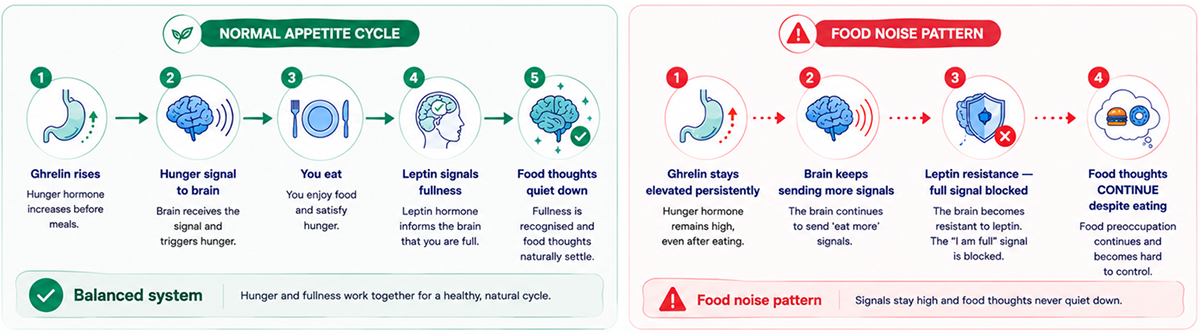
Ghrelin
Often called the hunger hormone, ghrelin is produced primarily in the stomach. It rises before meals and stimulates appetite.4
Leptin
Produced by fat cells. Signals the brain the body has enough stored energy. In obesity, the brain becomes resistant to leptin - the I am full message is never clearly received.4
Insulin
Released by the pancreas. When blood sugar spikes and crashes - from skipping meals or eating high-sugar foods - insulin fluctuations directly drive hunger signals and intensify food preoccupation.4
Peptide YY (PYY)
Released by the gut after eating. Signals the brain to reduce appetite. Lower levels in obesity mean the quietening signal arrives too late - leaving food noise active.4
When these hormones work together, they keep your appetite in check. But when the balance shifts — especially during weight changes — hunger and cravings can increase, making food noise louder and harder to manage.4
Living with food noise can affect your health in many ways
Over time, obesity can impact both physical health and overall quality of life.7
When the brain is constantly drawn to food, eating patterns become disrupted - driven by reward signals rather than the body's actual needs.³ These disrupted patterns can contribute to weight gain and increase the risk of metabolic conditions over time.7
61%
find it harder to stick to a nutrition or exercise plan6
60%
find it harder to make healthy food choices6
>50%
say food noise is a significant roadblock to their weight goals6
References
- Dhurandhar, E. J., Maki, K. C., & Dhurandhar, N. V. (2025). Food noise: Definition, measurement, and future research directions. Nutrition & Diabetes, 15(1), 30. https://www.nature.com/articles/s41387-025-00382-x
- Hayashi, D., Edwards, C., Emond, J. A., Gilbert-Diamond, D., Butt, M., Rigby, A., & Masterson, T. D. (2023). What Is Food Noise? A Conceptual Model of Food Cue Reactivity. Nutrients, 15(22), 4809. https://doi.org/10.3390/nu15224809
- Kanoski, S. E., & Boutelle, K. N. (2022). Food cue reactivity: Neurobiological and behavioral underpinnings. Reviews in Endocrine and Metabolic Disorders, 23, 683–696. https://link.springer.com/article/10.1007/s11154-022-09724-x
- Freire, R. H., & Alvarez-Leite, J. I. (2020). Appetite control: Hormones or diet strategies? Current Opinion in Clinical Nutrition and Metabolic Care, 23(5), 328–335. https://doi.org/10.1097/MCO.0000000000000675
- WeightWatchers. (2024). What food noise is and how to quiet it. https://www.weightwatchers.com/us/blog/food/what-is-food-noise
- STOP Obesity Alliance & WeightWatchers. (2024). WeightWatchers consumer research report — Food noise. George Washington University Redstone Global Center for Prevention and Wellness. WeightWatchers_Consumer_Landing_Page_2024.pdf
- Venkatrao, M., Nagarathna, R., Majumdar, V., Patil, S. S., Rathi, S., & Nagendra, H. (2021). Prevalence of obesity in India and its neurological implications: A multifactor analysis of a nationwide cross-sectional study. Annals of Neurosciences, 27(3–4), 153–161. https://pmc.ncbi.nlm.nih.gov/articles/PMC8455012/
- Kanu, C., Kimel, M., Clucas, C., Goetz, I., Neff, L. M., Boye, K. S., & Karn, H. (2026). Psychometric Validation of the Eating Behavior and Appetite Questionnaire (EBAQ) for Individuals with Obesity or Overweight. Advances in Therapy, 43, 817–833. https://doi.org/10.1007/s12325-025-03460-9
IN26OB00507
|
Oct 2026